
Deposit Assessment (“FDIC”) Fees
1. Understanding Deposit Assessment Fees
In U.S. commercial treasury banking, what corporate treasurers often refer to as an ‘FDIC Fee’ is formally internal bank recoupment for regulatory assessment costs. The Federal Deposit Insurance Corporation (FDIC) levies direct statutory assessments on insured depository institutions to maintain the Deposit Insurance Fund (DIF). Commercial banks routinely pass this overhead cost down to corporate depositors on demand deposit accounts (DDAs) and non-interest-bearing accounts.
Nomenclature Across U.S. Depository Institutions
Because this fee is a bank-imposed cost recoupment rather than a direct government tax passed through on an agency statement, institutions name and code it differently on monthly billing statements:
- Deposit Assessment / Deposit Assessment Fee – Common baseline billing description across national lenders.
- Deposit Administration Fee / Deposit Service Fee – Frequently used code for administrative recoupment.
- Balance Based Charges / Balance Admin Fee – Alternative naming tying fees directly to ledger holdings.
- Account Balance Fee / Regulatory Fee – Generic fee label for regulatory compliance recovery.
Balance Premium Assessment / Recoupment Monthly – Terminology emphasizing premium
2. Statement Complexity & Pricing Expressions
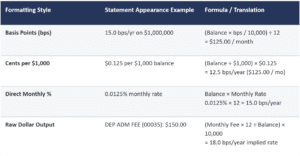
Account analysis statements are notoriously confusing when displaying deposit assessment fees. Institutions utilize disparate mathematical conventions, timeframes, and formatting rules, making direct comparisons difficult without audit standardizations.
Primary Sources of Statement Opacity
The underlying fee rate is determined as an annualized percentage or basis points per year (bps/year, where 100 bps = 1%), but billing occurs monthly (applying monthly prorated rate to monthly balances).
Annual vs. Monthly Rates:
Some banks express the fee as cents per $1,000 of deposit (e.g., $0.15 per $1,000 per month), requiring translation back to annualized basis points. Cents Per Thousand Convention:
Statements can also display only a final calculated dollar amount under an obscure internal code without disclosing the formula or rate applied.’Black Box’ Net Dollar Output:
Common Statement Formatting Conventions
Standardizing Your Effective Annual Rate
To audit charges where the underlying rate is omitted, corporate treasurers can reverse-engineer the true effective annual fee in basis points using the following formula:
Effective Annual Rate (bps) = [ ( Total Monthly Fee Charged ÷ Average Daily Collected Balance) × 12 ] × 10,000
3. Market Distribution and Benchmark Statistics
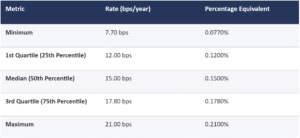
Based on benchmark pricing data across top financial institutions, assessment charges are expressed in basis points per year (bps/year, where 1 bps = 0.01%) assessed against average ledger or collected account balances.
4. Market Evolution & Historical Trends (2020–2026)
From 2020 through 2026, deposit assessment fee structures across commercial banks have exhibited three distinct market behaviors:
- Upward Re-pricing (Dominant Trend): The majority of major commercial lenders increased their baseline rates between 2022 and 2026. Typical upward adjustments shifted rates from historical ranges of 12.00–14.00 bps up to 16.00–20.00 bps. Key drivers include the FDIC’s uniform assessment rate increase effective January 2023 to rebuild the Deposit Insurance Fund (DIF) reserve ratio, alongside special regulatory recovery assessments following bank regional stress events in mid-2023.
- Stable / Unchanged Pricing: A secondary tier of institutions maintained static billing rates (e.g., locked at 13.00 bps, 16.00 bps, or 17.00 bps) continuously from 2020 through 2026, absorbing regulatory changes or holding legacy fee structures.
- Selective Compression (Exceptions): A minimal subset of institutions reduced their pass-through assessment rate (e.g., shifting down from 12.00 bps to 10.00 bps), primarily as a targeted strategy to remain competitive for operating liquidity.
5. Can Assessment Fees Be Negotiated?
Direct Fee Rate Negotiation: Generally, no BUT:
Standard corporate accounts rarely receive direct percentage discounts on underlying assessment fee rates, as banks view regulatory recoupments as non-negotiable overhead tied to capital and insurance requirements. However, many banks frequently waive these fees entirely. Because assessment fees directly factor into Earnings Credit Rate (ECR) performance, it is often unclear whether a bank is genuinely forgiving the fee or simply absorbing it by reducing the overall ECR. As always, there is only one rule: “If you don’t ask, you don’t get!”
Structural Compensation via ECR: Yes
While the line-item fee rate is rigid, commercial clients successfully offset or negotiate the net financial impact of assessment fees using the Earnings Credit Rate (ECR) framework. Make sure this rate if on top quartile of all ECR rates in the market and always compare net ECR (Gross ECR – “Assessment Fee”)
Strategic Client Takeaways & Action Plan
Negotiation Focus: Rather than attempting to lower an assessment fee rate from 18 bps to 15 bps, clients achieve better execution by negotiating a higher nominal ECR or requesting a reduction/waiver on core transaction and account maintenance fees.
Benchmarking Alignment: If a client’s current assessment fee exceeds the 3rd Quartile (17.80 bps) or maximum market boundaries (21.00 bps), the treasurer should leverage relationship review discussions to align the fee closer to the market median (15.00 bps).