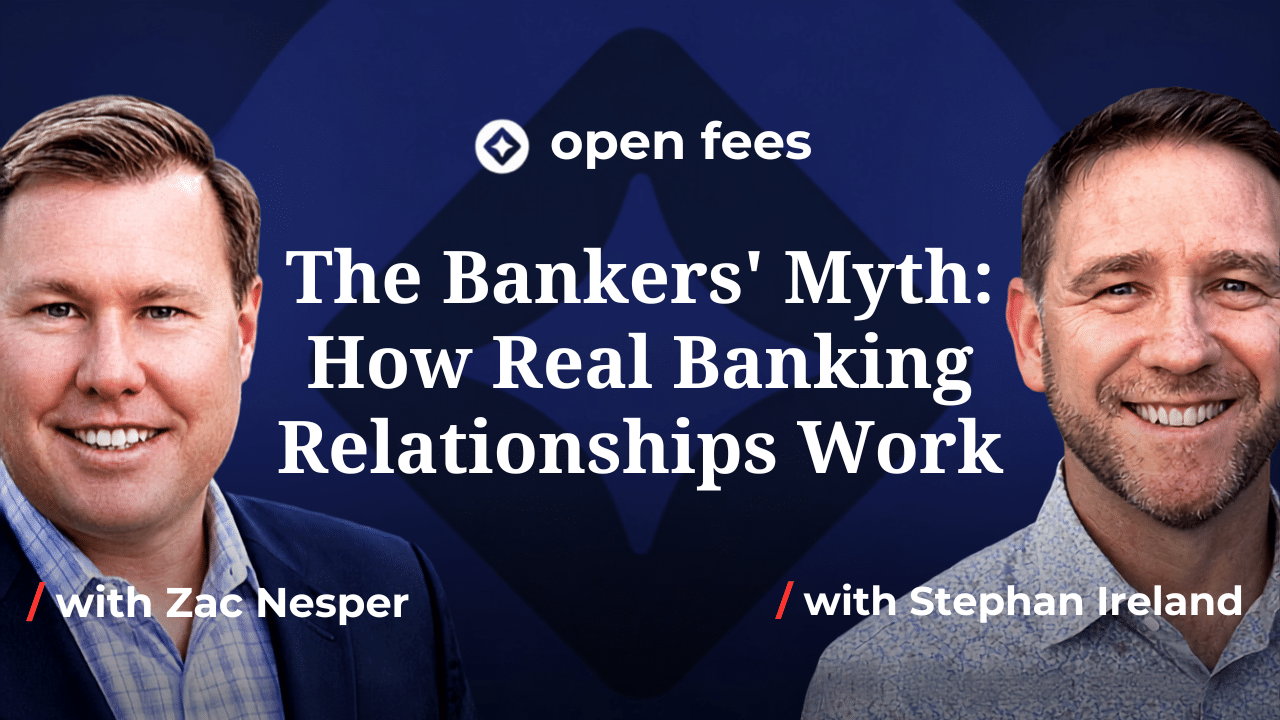
In the debut episode of The Open Ledger, host Stephan Ireland sits down with Zac Nesper, founder of Treasury Outcomes and former treasury leader at HP, to challenge common assumptions about enterprise banking relationships. Their conversation explores why strong banking partnerships require more than friendly rapport or competitive pricing. They demand transparency, accountability, consistent performance, and an understanding of what matters to both the company and its banks.
For treasury leaders managing complex global banking networks, these lessons are especially relevant. Enterprise treasury teams may work with a handful of core banks or dozens of regional, transactional, and specialist providers. The goal is to build a banking structure that can support operations, provide insight during high-stakes decisions, and perform when the business needs it most.
Bankers are neither friends nor enemies
The episode opens with what Zac calls “the banker myth.”: the idea that a banker is either a trusted friend or an adversary working against the company. In reality, he argues, neither extreme is useful. Banks exist to provide solutions, financing, expertise, and transaction support, but they also need to earn an appropriate return on the relationship.
As Zac puts it, bankers can help move a business forward through valuable advice and solutions, while also charging fees or earning spreads that may not always be immediately visible. That does not make them enemies. It means treasury teams need a clear-eyed approach to managing banking relationships.
For enterprise treasury teams, the takeaway is to avoid black-and-white thinking. A relationship can be collaborative and commercially disciplined at the same time. In fact, that balance is often the foundation of a sustainable long-term partnership.
The best bank relationships are strategic
Zac separates banking relationships into two broad categories: strategic and transactional. Transactional relationships help companies run the business efficiently through payments, accounts, credit facilities, FX, and other services. Strategic relationships go further by helping treasury leaders navigate major business decisions, financing events, market volatility, and corporate change.
The distinction becomes clear during consequential moments. Zac describes HP’s experience responding to a hostile takeover attempt, where its advisers brought practical insight into takeover defense, potential pitfalls, and how the company should conduct itself. Those were the partners he wanted “in the room when the chips are down.”
That is an important standard for enterprise treasury teams. A bank’s value should not be measured solely by a pricing grid, product lineup, or the volume of business it receives. The real question is whether it can bring relevant expertise and informed solutions to the organization’s most important problems.
Transparency requires scorecards and dialogue
For Zac, the most important ingredient in a good banking relationship is transparency. Treasury teams should communicate what banks are doing well, where they need to improve, and what is changing inside the business. That visibility allows banks to offer relevant support instead of generic solutions.
At HP, that transparency was supported by a banking scorecard prepared before major meetings, particularly when the CEO or CFO was involved. The team looked at multiple dimensions of the relationship: product purchases, estimated FX revenues, revolver participation, bond-deal activity, share of wallet, operational performance, and qualitative service measures.
Integrity appears when a bank says no
Not every useful bank interaction involves a product recommendation. Zac suggests one of the best signals of integrity is whether a bank will tell a client not to pursue an option that would be profitable for the bank.
He recalls situations in which bankers advised against executing a bond deal at a particular time. Treasury leaders take note of that kind of advice because it suggests the bank is considering the client’s broader interests, not merely its own revenue opportunity.
By contrast, Zac shares a story from the financial crisis, when a bank spent most of a meeting urging HP to buy collateralized debt obligations amid severe market volatility. Whether the investment itself might eventually have been attractive was not the central issue. The problem was the lack of judgment and awareness surrounding the recommendation in that moment.
Big moments reveal the real partnership
Major transactions, market disruption, and corporate transformation can reveal more about a banking relationship than years of routine service. Zac points to several examples from his experience, including takeover defense and HP’s separation into two companies within nine months.
During the separation, Citibank, HSBC, and BNP provided resources that helped the company open 800 bank accounts worldwide in six months. That is what a strategic bank relationship looks like in practice: a partner deploying expertise, resources, and urgency to help a client execute a difficult initiative.
A notable soundbite from this section is that treasury leaders should “take notes” and change their behavior based on which banks help and which do not. A useful test is how a bank responds when it does not receive a bond mandate or active-book role. Does it seek constructive feedback and work to improve its position? Or does it react with frustration and sour grapes?
Be tough, fair, and strategic
The conversation closes with advice for current and emerging treasury leaders: do not be only an operator. Be a strategist, too. Zac believes treasury professionals should continue running operations effectively while bringing proactive analysis and insight to the CFO, CEO, board, and other decision-makers.
That includes understanding how banks think. Banks consider return on capital, revenue potential, risk exposure, and the broader commercial value of a client relationship. Treasury teams should track share of wallet, consider whether banks are receiving a fair opportunity to earn business, and evaluate whether they are delivering the service and intelligence that justify that opportunity.
Technology and AI may accelerate transaction cycles, M&A integration, and access to information, but the central principles of banking relationships will remain. Treasury leaders who combine operational discipline with strategic judgment will be better equipped to use their bank network as a source of insight, resilience, and value.
Listen and subscribe
If you found this episode useful, make sure to follow The Open Ledger for more conversations about banking relationships, fees, treasury strategy, and the hidden costs that shape financial performance.
Watch or listen: